TEXT GULNARA ISMAILOVA PHOTO ULVI DASHDAMIR
The history of Moët & Chandon is inseparable from motorsport and the culture of victory. As early as the 1930s, the champagne was already accompanying triumphs on racing circuits. In 1950, Juan Manuel Fangio visited the House’s historic residence, Château de Saran, following his victory at the French Grand Prix. Seventeen years later, Dan Gurney helped popularise the tradition of celebrating victories with champagne after winning the 24 Hours of Le Mans. In 1981, Moët & Chandon became an official supplier to the FIA, and in 2025, it returned to Formula 1 as the championship’s Official Champagne.
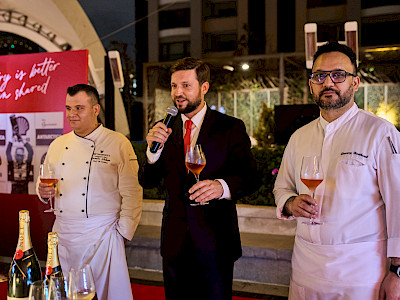
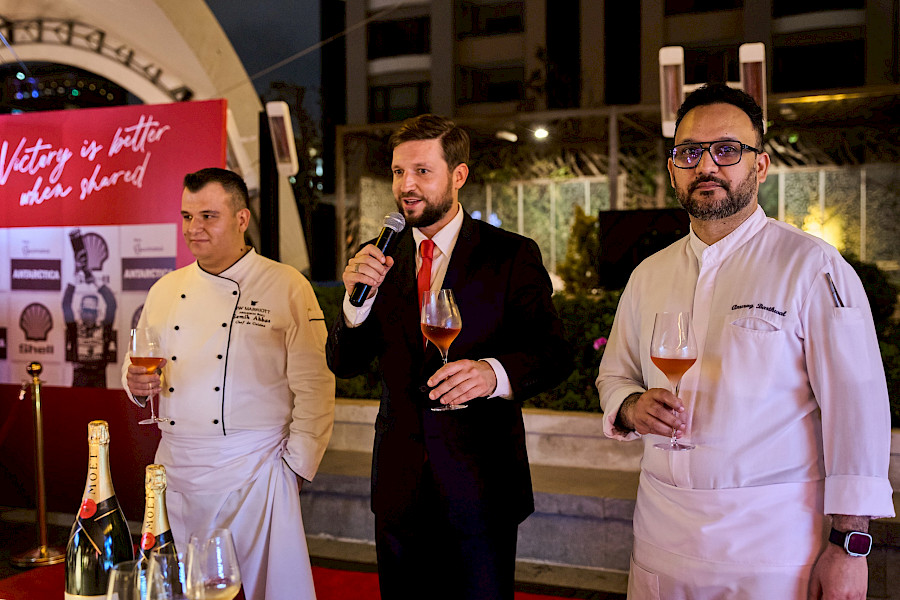
In Baku, this remarkable legacy came to life at an exclusive dinner inspired by the world of Formula 1. Guests were welcomed with Moët & Chandon Brut Impérial, while the spectacular unveiling of a champagne tower set the tone for the evening. First created in 1869, Brut Impérial is the House’s signature cuvée. Its distinctive style combines vibrant fruitiness, elegant maturity and the art of blending more than 100 wines, including carefully selected reserve wines.
The gastronomic experience showcased the character of each cuvée. An oyster with lime was paired with Brut Impérial, followed by sea bass ceviche with lemongrass, pomelo and avocado, accompanied by champagne served from a Magnum bottle. Tasting champagne served in different bottle formats offered guests an opportunity to discover how bottle size influences its evolution, revealing subtle differences in texture, freshness and aromatic expression.
The highlight of the evening was the presentation of a historic Jeroboam bottle of Moët & Chandon bearing the signatures of Ayrton Senna and the other podium finishers of the 1991 Brazilian Grand Prix. That year, Senna secured his long-awaited first victory on home soil at the Interlagos circuit, overcoming severe physical exhaustion and gearbox problems. It was also the year Moët & Chandon began preserving Jeroboam bottles signed by Formula 1 podium finishers. Over time, the collection grew to include 51 bottles.
To commemorate the occasion, guests were introduced to Moët & Chandon Grand Vintage 2016, the House’s 77th vintage release. Unlike Brut Impérial, which maintains the House’s signature style regardless of the harvest year, Grand Vintage expresses the distinctive character of a particular year through the creative vision of Chef de Cave Benoît Gouez.
Despite the challenging weather conditions of the 2016 harvest, the resulting champagne achieved remarkable harmony and elegance. After six years of ageing in the cellars, it revealed delicate notes of roasted hazelnut, brioche, stone fruit and flowers. Its refined complexity was complemented by roasted sturgeon served with fennel, citrus velouté and herb butter.
The evening concluded with Moët & Chandon Rosé Impérial, whose expressive red-berry notes harmonised beautifully with an original dessert featuring peach crémeux, compressed tomato, basil and strawberry granita.
For me, the event was about more than visual elegance and refined gastronomy. The historic bottle bearing Senna’s signature was a reminder of how sport can transcend the racetrack and become part of global culture. The presentation also held particular significance, as 2026 marked the 35th anniversary of Azerbaijan’s restoration of independence. I found it particularly fascinating that the story of Senna’s 1991 victory in Brazil resonated with this milestone. These two very different stories, separated by geography and circumstance, converged in Baku – and I believe this is what makes events of this kind truly meaningful.
Formula 1 is about more than speed and competition. It is about character, legacy and the ability to create moments that grow in significance with time. And Baku, with its own history, energy and distinctive character, has its own way of becoming part of this world.