With exhibitions at the Royal Academy of Arts, the Brooklyn Museum, and the Saatchi Gallery, Levan Songulashvili has become one of Georgia’s leading contemporary artists. Yet, behind the international recognition is an artist driven by curiosity, philosophy, and a lifelong desire to understand the world through painting. In this exclusive interview with N13 Magazine, he reflects on the ideas that shape his practice, the people who influenced his journey, and why authenticity has always mattered more than recognition.
You began painting at a very young age. Pursuing an art career is often seen as an unconventional path. How did your family react when they realised it was more than a childhood hobby?
There was no dramatic moment when my family suddenly realised that art was more than a childhood hobby. I began drawing before I could speak. I sometimes joke that, within myself, I retraced humanity’s journey from the cave wall to the present day: drawing was my first language, life became a journey, and painting eventually became the place where my identity took form.
By seven, I was already absorbed in mythological scenes, surreal compositions, portraits, and figures in motion. By nine, literature had begun to expand that world. Shakespeare came first; Dostoevsky, Kafka, Mann, Hesse, and Calvino followed later. What began as an instinct to draw gradually became a broader way of thinking about mythology, psychology, history, and human nature. My mother raised me on her own, and her role in my life is immeasurable. I was born in 1991, as Georgia regained independence amid political upheaval, civil conflict, and economic collapse. Within that fractured world, she understood that drawing wasn’t simply something I loved, but how I made sense of reality. She made sure I drew every day, yet never tried to define the artist I should become. Instead, she protected the freedom that allowed me to discover that for myself. Looking back, I see it as an act of faith. She gave me devotion without possession, guidance without control, and freedom in a country struggling to understand its own.
Your practice spans painting, video, installation, and multimedia. How do you decide which medium best expresses a particular idea?
I rarely choose a medium in advance. An idea first emerges as an image, rhythm, or psychological tension, and I follow it until its form becomes inevitable. Had painting not claimed me, I might have become a composer, filmmaker, or writer. I am a self-taught pianist, but I also write fiction, philosophical essays, and personal reflections. They are different forms of the same impulse: to examine experience and give form to what resists articulation.
My paintings are often cinematic in their construction and scale, while the relationship between gesture, line, and repetition is fundamentally musical. I often experience something close to synaesthesia: colour suggests tone, a line carries rhythm, and an image contains silence.
In 2019, I explored this relationship through a four-hour live performance, Synaesthesia, staged in New Kimerioni, the underground space beneath the Rustaveli National Theatre, where I painted in response to music improvised by three musicians, while they responded to the movement of my brush and the abstract image emerging before them. The exchange unfolded in real time and was projected to a full theatre audience. The work dissolved the boundary between seeing and hearing, action and response. This is why video, sound, sculpture, and site-specific installation enter my exhibitions so naturally: they are extensions of the same conceptual and emotional body. Yet painting remains the primary and irreplaceable language of my practice.
Has working across different media changed the way you think about painting?
Yes. Each medium possesses a particular timbre and emotional capacity. Video unfolds through time; sound constructs an invisible architecture; installation places the viewer physically inside a situation. Painting operates differently: it compresses action, memory, tension, and time into a single surface, allowing contradictions to remain active rather than resolved. Photography and cinema once compelled painting to reconsider what only it could do. AI is exerting a similar pressure now. Images can be produced, altered, and multiplied with almost no friction, while the boundary between the human and the generated grows increasingly unstable. Rather than threatening painting, it makes the human trace more consequential. The more I work beyond painting, the more I understand why I return to it. Other media extend the work, but painting remains the place where thought becomes physical.
Your work often gives form to things that cannot be seen: memory, spirituality, emotion, and time. Do you see your practice as an attempt to make the invisible visible?
Not exactly. The invisible isn’t another world; it is what the visible can’t contain. I don’t paint the event itself. I paint its persistence: how it settles in the body, changes in memory, and passes into a collective condition. In my work, a single figure may dissolve into a multitude, while a crowd suddenly carries the solitude and vulnerability of one person. That unstable exchange between the intimate and the historical, the one and the many, is central to my practice. I am not interested in translating the invisible into a fixed symbol, but in allowing it to acquire weight, distance, pressure, and presence. The image is complete when what can’t be seen begins to determine what can.
The title Noli Me Tangere is rich in religious and philosophical meaning. What drew you to this phrase, and what questions were you hoping to explore through the work?
Few phrases have carried so many contradictions across history as Noli Me Tangere. In the Gospel of John, Mary Magdalene recognises the resurrected Christ at the moment he tells her not to hold him. Presence is restored, yet touch is denied; recognition arrives with separation. That paradox was my point of departure. Over the centuries, the phrase travelled beyond theology into painting, literature, medicine, law, and politics, naming what is sacred, forbidden, or too dangerous to touch. I was drawn less to the prohibition than to the instability of touch: it can console or violate, create intimacy or erase a boundary.
I made the painting in 2022, when the pandemic had transformed the social and psychological meaning of proximity, and Russia’s full-scale invasion of Ukraine had imposed a new reality of occupation and forced migration. The body and the border began to mirror one another: both could be protected, crossed, occupied, or abandoned. On 24 February 2023, marking the first anniversary of Russia’s full-scale invasion of Ukraine, Noli Me Tangere was exhibited at Georgia’s Presidential Palace at the initiative of then-President Salome Zourabichvili. The painting later entered the collection of the Georgian Museum of Fine Arts. The work emerged from the collision of these realities. Without reproducing the biblical episode, it brings its central contradiction into our own time.
From exhibiting at the Royal Academy, the Brooklyn Museum and the National Gallery of Georgia, to winning the Global Talent Art Prize, your career has evolved remarkably quickly. Has this recognition changed your creative priorities or the way you approach your practice?
Recognition hasn’t changed my priorities; it has only deepened my commitment to them. The impulse that took shape in childhood remains: to follow the work wherever it leads, with freedom and discipline. Recognition can strengthen one’s resolve, but never become the reason for creating or the measure of the work. The deepest satisfaction is still the most private: completing a painting and, almost immediately, sensing the next work begin. Public recognition belongs to the life of the work after it leaves the studio. My attention remains with the work that doesn’t yet exist.
Every artist faces moments of uncertainty. Were there times when you doubted yourself or questioned your path? If so, what helped you move forward?
I have never doubted the path itself. Life is too brief to turn away from what has defined you from the beginning. Curiosity leads me to question the world, its assumptions, histories, and inherited certainties, but never the necessity of painting. For me, self-belief isn’t about success; it is fidelity to one’s nature. The most difficult periods of my life haven’t taken me away from the work; they have returned me to it. Painting is where my inner voice becomes most audible, and following it has always shown me the way forward.
I have never doubted the path itself. Life is too brief to turn away from what has defined you from the beginning.
Could you tell us about the idea behind Idem et Idem? What inspired the work, and what does it represent for you?
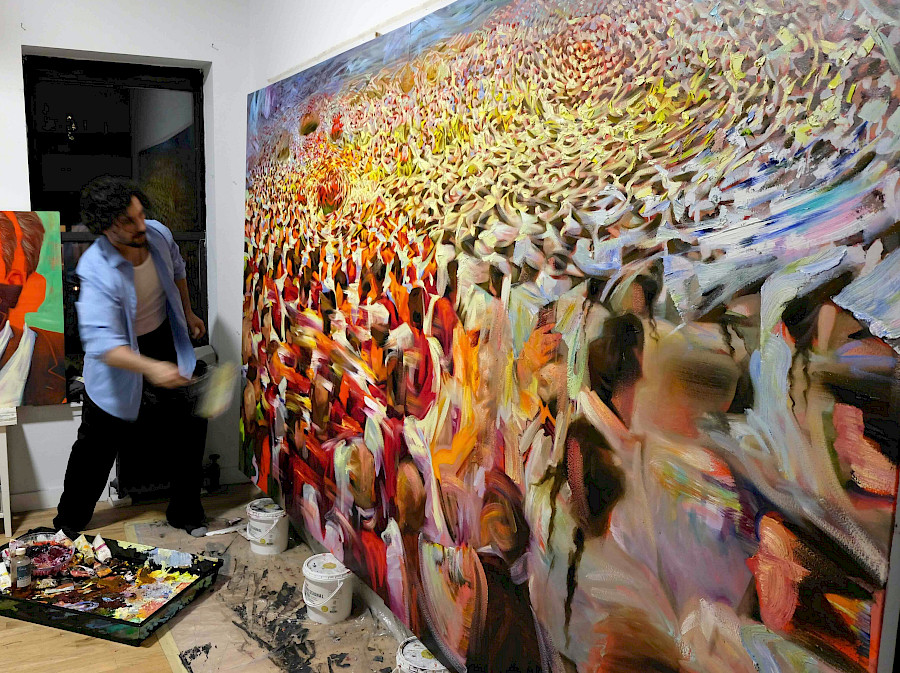
Idem et Idem is one of the central bodies of work to which I continue to return. Although the series revolves around repetition, it isn’t concerned with repetition in its literal sense. Time, memory, migration, and history recur, but never unchanged. I come from a geography where home is inseparable from memory, loss, and displacement. Here, however, home isn’t simply architecture or territory. It may be the body, language, a community, or the historical moment one is compelled to inhabit. The figures have already moved beyond shelter, into indeterminate territories where identity is exposed to distance, movement, and transformation.
I don’t place figures within a landscape. The crowd is the landscape; the collective body is the horizon. The individual remains visible, but never entirely autonomous and absorbed into the many. The figures don’t conquer the unknown; they are altered by what remains beyond their reach. In my most recent painting from the series, the white bodies aren’t painted; they are intentionally formed by the canvas’s untouched ground, so the image emerges as much through restraint as through application. The ground is no longer a neutral support; it becomes an active element of the composition. White ceases to function as colour and becomes space. In 2018, the Georgian composer Giya Kancheli visited my solo exhibition and encountered Idem et Idem for the first time. He stood before the painting for a long while, asked me about it, and then asked his wife to note the title, saying he intended to give it to a new choral composition. At its world premiere, the painting defined the concert’s visual identity and formed the basis of the stage installation. Kancheli died shortly afterwards, and Idem et Idem became one of his final compositions.
What is your biggest dream?
Some dreams need silence before they can enter reality.
Is there a message you would like to share with our readers?
Don’t confuse visibility with meaning, speed with progress, or attention with love. Find the voice that is truly your own and protect it from imitation, convenience, and the pressure to be understood too quickly. Stay close to those who preserve your humanity. The world isn’t a backdrop to our lives, but a living inheritance entrusted to us. Time isn’t something we possess; it is what a life is made of.